2017 Art Review + Schoolism Gesture Drawing
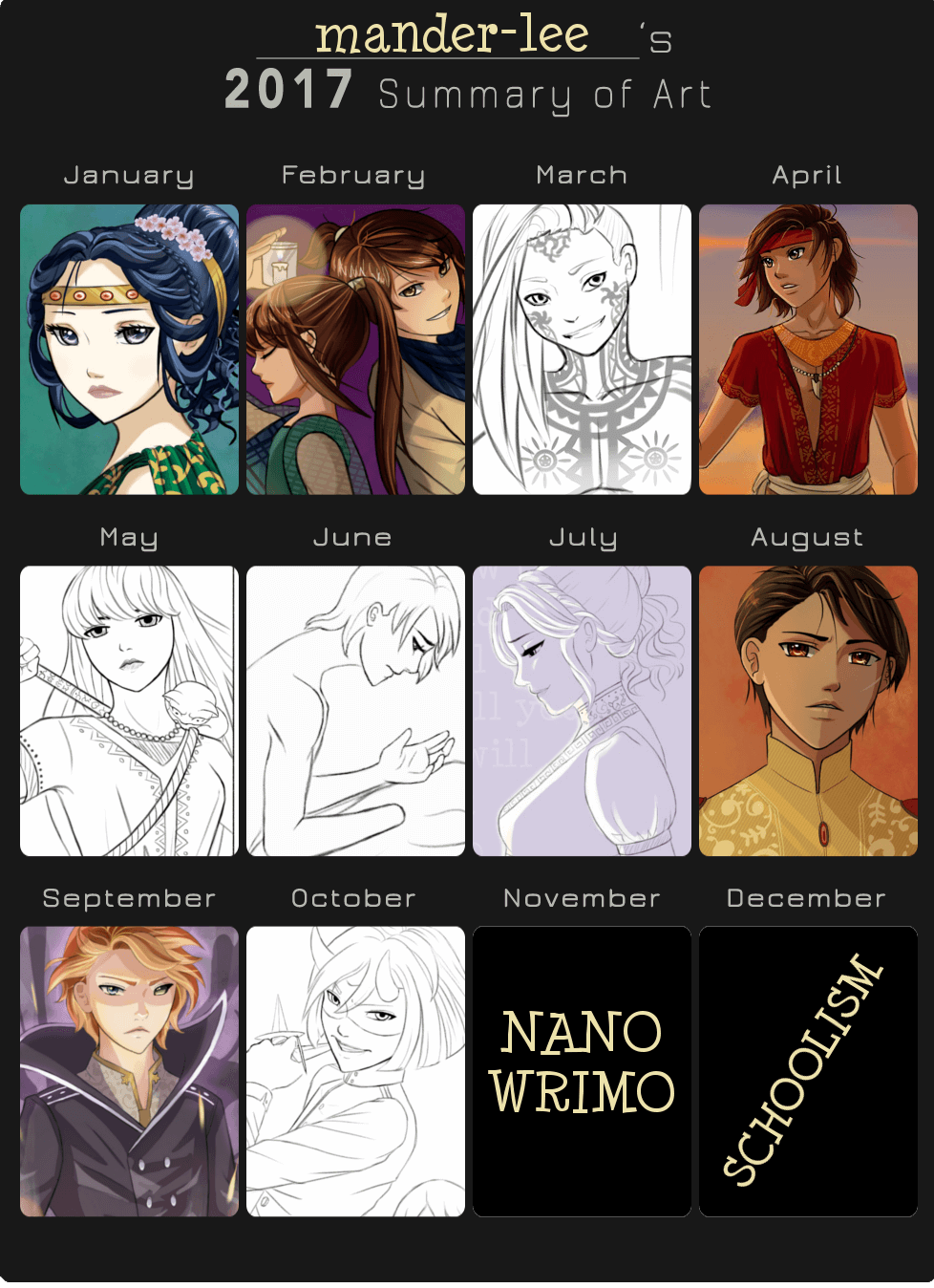
At the beginning of last year, one of my new year's resolution was to make at least one coloured art piece a month. I totally failed that resolution. At first it was just because I didn't have time, but as the year progressed it was because of an increasing dissatisfaction with my artwork. Even at the sketching stage, I felt increasingly frustrated with my art that I just didn't bother to colour them in.
In November, I participated in NaNoWriMo so I didn't have time for art at all. In December, I finally decided to take some online art lessons to improve. I chose schoolism.com because after shopping around for online courses, this was the only one I found that is a good match for my current skill level without passing my budget. I opted for the 1-year subscription instead of the critiqued classes so I can learn at my own pace.
Throughout December, I worked my way through the gesture drawing course taught by Alex Woo. It was a lot of fun and I learned a lot. I think the best part about the structure of the course is that you can see the critiques for the students who took the critiqued sessions, so you get to see how other people are doing and have a better idea of how to improve your own skills.
Here are a few samples of my work from the course. Mind you, these are not polished. The course is typically 7-week long and I breezed through it in December for personal reasons. If I had taken the critiqued sessions, I would definitely polish my drafts a bit more. So if you think, "Oh these are not that good," definitely blame it on my rush and not on the quality of the course. There were student submissions that were awesome. As a matter of fact, I was really surprised to see some amazing works that seemed to be getting only 3-stars from the instructor, so based on those, I'm pretty sure these drafts would be 1 to 2 stars only.
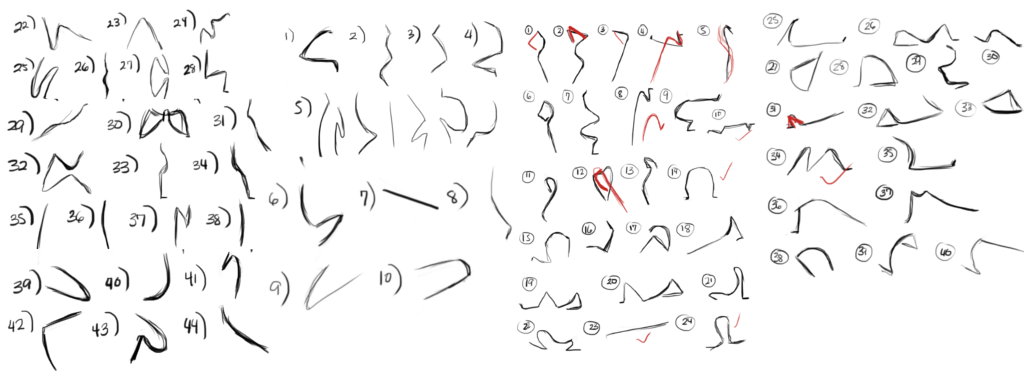
Lecture 1: Line of Action
The line of action is about distilling a pose into a single line to capture the main idea or the main movement of the body. These sketches are probably not gonna make much sense without the actual poses as reference, just putting that out there.
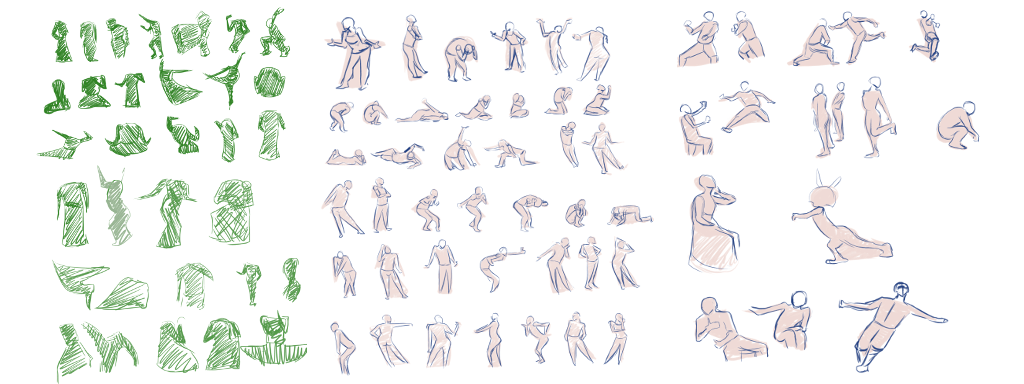
Lecture 2: Shape
Like the line of action, shape tries to distill a pose into a single entity that captures its main feeling. It's great for composition because you know what space your figure is taking up.
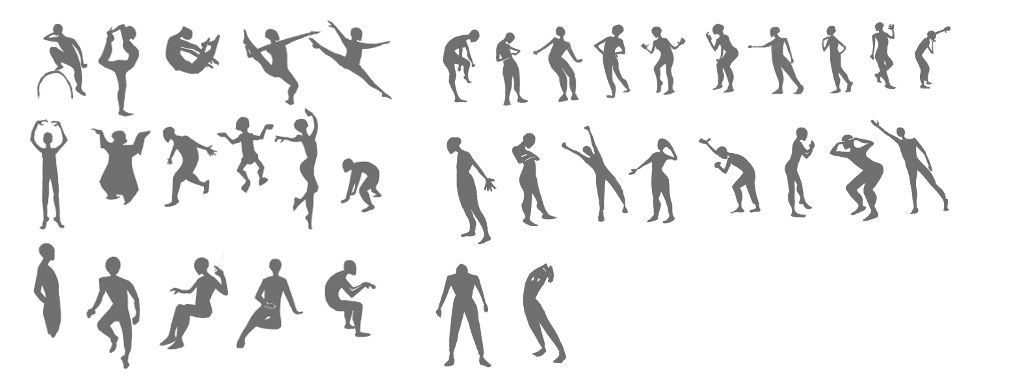
Lecture 3: Silhouette
This is one of the most important things I learned in the course. Silhouette is about capturing the action of your figure even without details. In a good gesture drawing, the action of your figure must still be recognizable even if the figure is completely blacked out. I think one of the problems I had before was that a lot of the poses I drew my characters in had terrible silhouettes. I had a lot of fun doing the exercise for this lecture.
Lecture 4: Space
I didn't do the homework for this lecture, because I was so excited about the upcoming ones. I know, I'm terrible. But this lecture is about establishing a sense of 3-dimensionality in your figure. For example, putting your figure's feet in different altitudes to establish perspective.
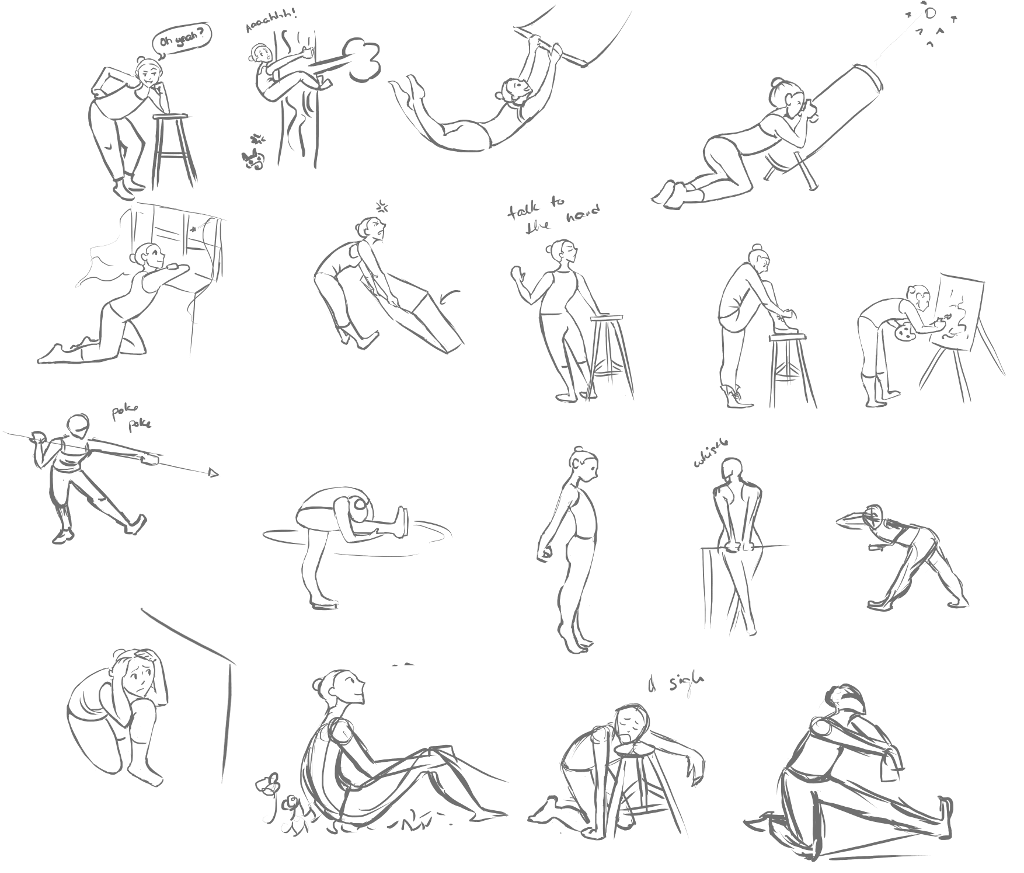
Lecture 5: Exaggeration
This was one of my favourite lectures. I probably failed it but it was so informative. Exaggeration is about taking the idea of a pose and exaggerating the figure so that the idea becomes more pronounced. For us to do the sketches, we had to assign a story to the poses so that we know how to exaggerate it. Some of these worked out better than others. I wonder if we were supposed to really stick to the 2-minute time frame. I spent about 5 to 10 minutes on the better ones here, but even they don't look as good as the ones that the other students handed in.
Lecture 6: Extrapolation
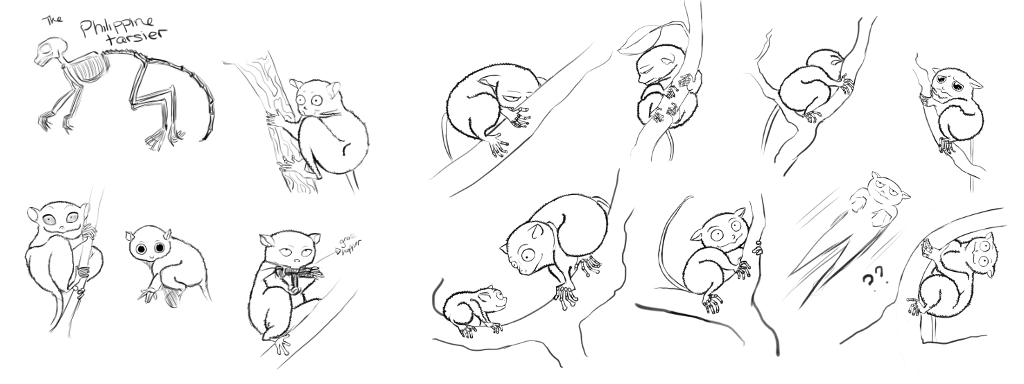
Extrapolation is about using the main idea of the model's pose and applying it to another thing, like an animal. For this lecture we were asked to study the anatomy of an animal and to do all the exercises using this animal. To my everlasting regret, I chose the Philippine tarsier, because it's an animal that appears in my story, and I thought it would be good to practice drawing it. But this ended up being a poor choice. The tarsier is curled up in itself most of the time; it can't really stretch its arms, and it rarely stretches its legs (only to jump). So I had a lot of difficulty applying the stretched-out poses. I tried to have the head and eyes capture the main idea, but there's only so much variability I can do. Either that or I'm just not terribly creative.
Lecture 7: Story
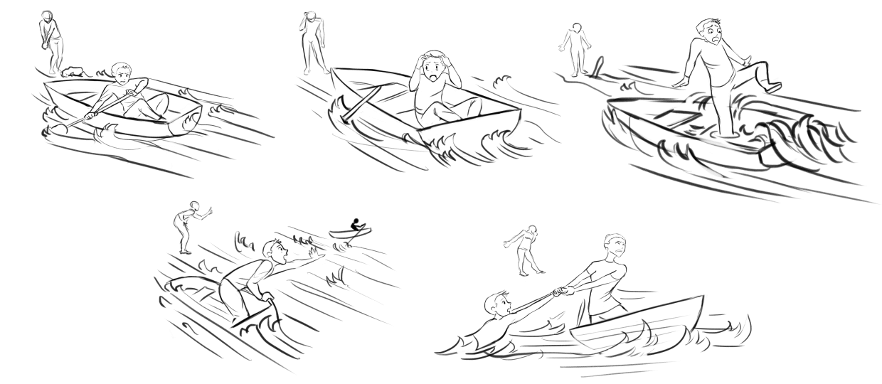
Story is about using a pose in a larger context of a story. For this lecture we were assigned to come up with a story using a series of poses. In the sketch below, you'll see the poses in the upper left corner. I ended up modifying most of them to fit my story.
And that's it! What a ride! I learned so much from this course, and even if I rushed it, I will certainly keep the lessons in mind and apply them to my future artwork.
Want to leave a comment on this post? Send me a message through my contact form or ask on Tumblr.